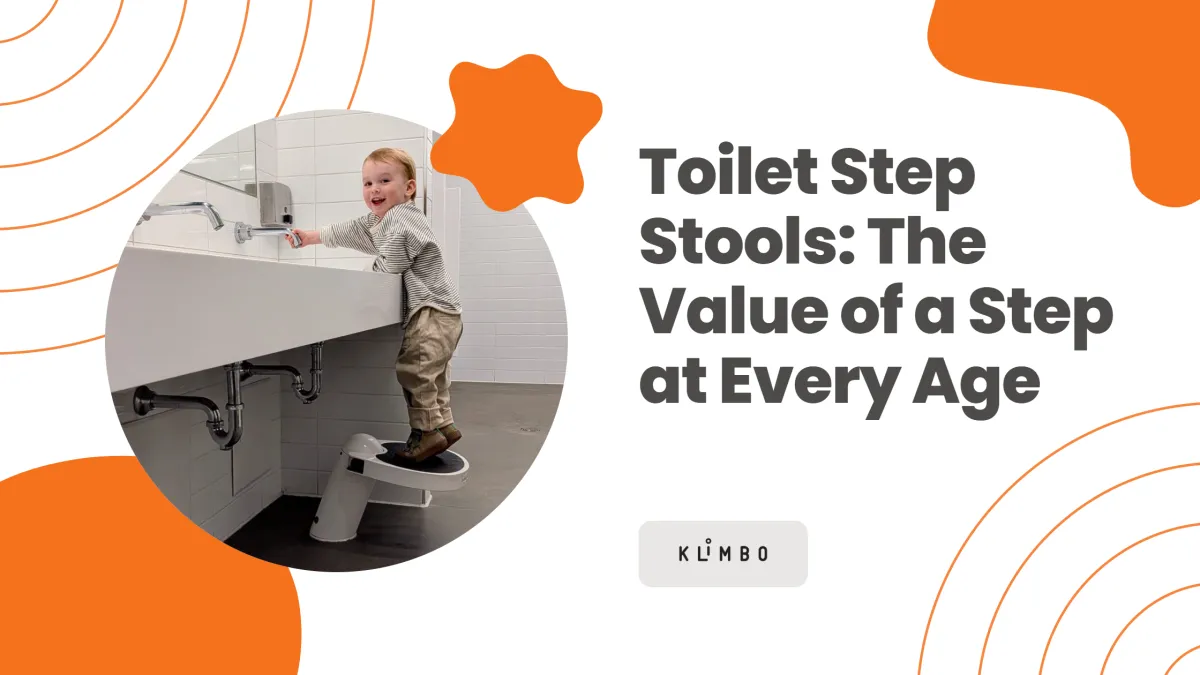
Toilet Step Stools: The Value of a Step at Every Age
Updated September 2026.
A toilet step stool is a low, stable platform that lets someone reach a toilet or a sink without help. In a public restroom it quietly serves three groups at the same time: young children, older adults, and shorter adults who simply cannot get their feet flat on the floor.
Most public washrooms are built to one height. The fixtures are mounted for an average adult, and everyone outside that average is left to improvise. A child climbs. An older person shifts their weight onto a grab bar that was never meant to carry it. Somebody drags over a garbage bin. None of that is a design decision, and all of it happens every day in buildings that are otherwise well run.
What a toilet step actually solves
The obvious problem is reach. The less obvious one is posture.
When feet dangle, the body has no base. A small child on a standard toilet has nothing to push against, so they hold the seat edge with both hands and stay tense the whole time. Physiotherapists have made the same point about adults for years: a slightly raised footrest changes the angle of the hips and makes the toilet easier to use. A step is not a comfort accessory. It is the part of the fixture that was left out.
At the sink, the problem is simpler and more visible. If a child cannot reach the tap, they do not wash their hands. They rinse one hand, or they skip it, or an adult lifts them and gets soaked. In a building that serves hundreds of families a day, that adds up to a hygiene gap nobody planned for.
Who needs a step in a public restroom
It is worth being specific, because facility teams often assume this is only a question of children.
Young children. The clearest case, and the one parents notice immediately.
Older adults. A raised footrest reduces strain and gives a stable point to push from when standing back up.
Shorter adults. Many people sit on a standard toilet with their feet off the floor. Most never mention it.
People with limited mobility. Accessibility codes deal thoroughly with wheelchair clearances and transfer space. Standing vertical reach, for someone who walks but cannot stretch, is largely absent from them.
That last point matters. A restroom can meet every published clearance requirement and still leave a five year old unable to wash their hands.
What are the benefits of using a step stool at the toilet?
Four things change once a proper step is in place.
Independence. The person uses the fixture alone. For a parent travelling with two children, that is the difference between a two minute stop and a small ordeal.
Hygiene. Handwashing actually happens, and it happens properly, because the person can reach the soap and the water at the same time.
Safety. Climbing on a toilet rim or a sink pedestal is how falls happen in public buildings. A stable platform removes the improvisation.
Liability. A loose stool left on the floor is a trip hazard for the next visitor, and it is the facility that owns that risk, not the person who moved it.
Why portable toilet steps fail in public buildings
Portable steps work at home. In a public restroom they fail for reasons that have nothing to do with the product itself.
They move. Within a week a portable step has migrated to a corner, into the accessible stall, or out the door entirely. They collect water and become slippery. They are not made for five hundred users a day. And when they are not in use, they sit in the middle of the floor, which is exactly where a cleaner with a cart or a visitor with a cane does not need them.
This is the reason retractable steps exist. The platform is there when it is needed and folds away when it is not, so the floor stays clear and the step stays where it was installed.
What to look for in a commercial toilet step stool
If you are specifying one for a public building rather than buying one for a house, five things matter:
Fixed position. It has to stay where you put it. Klimbo's K01 and K02 are anchored to the floor; the K03 is modular and repositionable when a fixed install is not an option.
Hands free operation. A foot operated mechanism means nobody touches the step with their hands in a room full of surfaces they would rather not touch.
Clear floor when retracted. The step should fold out of the traffic path, not sit in it.
A slip resistant platform that stays that way when wet.
Cleaning that fits the existing routine. If maintenance has to do something extra every day, it will not last.
Specifying a step at the sink or the toilet? The K01 and K02 floor-anchored retractable step stools meet every point on that list: foot operated, folded out of the traffic path when not in use, slip resistant, cleaned with the room. US buyers: see the K01 and K02 page or request a quote. For the ADA numbers at the sink, see the 34-inch rule and the children's gap.
Frequently asked questions
Is a toilet step stool the same as a potty step?
No. A potty step is a home product sized for one child. A commercial toilet step is a fixture, sized and built for continuous public use.
Does a step at the toilet help adults?
Yes. Raising the feet changes the hip angle and gives a stable base for standing up. It is one of the reasons footrests appear in accessible bathroom design.
Where should the step go, at the toilet or at the sink?
The sink is usually the higher priority, because that is where handwashing is lost. In family and accessible stalls, both positions are worth considering.
Do retractable steps get in the way of cleaning?
A retracted platform leaves the floor clear, which is generally easier to clean around than a loose stool that has to be picked up and put back.
Where to go next
If you are looking at this for a school, an airport, a municipal building or a restaurant, the model choice depends on traffic and on whether you can anchor to the floor.
Start with our overview of commercial step stools to compare the three models side by side, or look directly at the Klimbo K01, the model most often specified for high traffic public washrooms.Related reading: folding step stools: common uses and how to choose one, how to improve child accessibility in public bathrooms without renovation and commercial bathroom accessibility standards.
