Folding Step Stools: Common Uses and How to Choose One
Updated September 2026.
A folding step stool is a step that stows away when nobody is standing on it. Some fold flat and get carried around; others stay in place and fold up against the fixture. In a public restroom the difference between those two matters more than anything else.
The word covers a wide range of products, from a plastic step you buy for a kitchen to a fixture bolted into the floor of an airport washroom. They solve the same problem, reach, but they behave very differently once a few hundred people a day are involved.
What are the common uses of a folding step stool?
Four uses account for most of them.
Reaching a sink or a counter. The most common by far, and the reason folding steps end up in bathrooms and kitchens.
Helping children use a fixture built for adults. Toilets, sinks and taps in public buildings are set at one height, and children are simply outside it.
Short term access to something stored high. A stockroom, a supply closet, a shelf above eye level.
Giving shorter adults and older adults a stable base. Often unspoken, but very real in a restroom where feet do not reach the floor.
The first two are what public facilities actually deal with. The others belong at home or in a back office.
Folding, fold away, retractable: what the words mean
People search for all three, and vendors use them loosely. The useful distinction is not how the step folds but whether it stays put.
A portable folding stool is a loose object. It folds flat, it can be carried, and it goes wherever the last person left it.
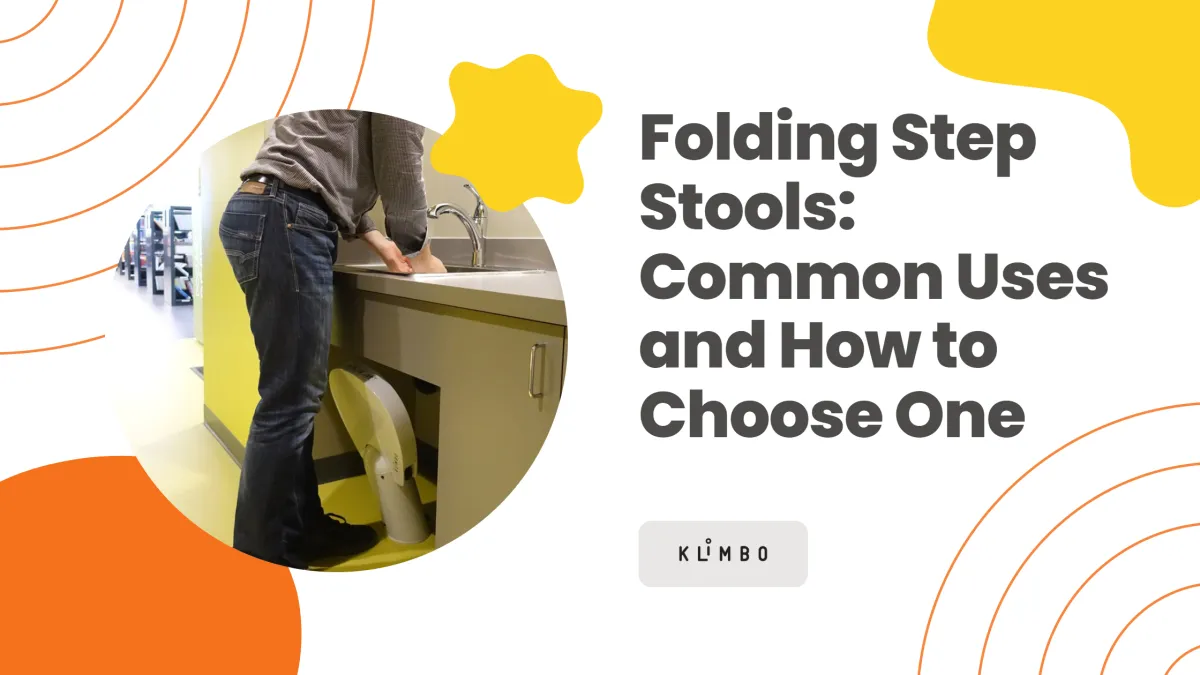
A fold away or retractable step is a fixture. It is installed in one position and the platform folds up out of the way between uses. Nobody carries it anywhere because it is attached to the building.
Both are correctly described as folding. Only the second one is still in the right place next Tuesday.
Where a portable folding stool stops working
Portable steps are excellent at home. A family knows where theirs lives, one or two people use it a day, and if it wanders somebody puts it back.
None of that holds in a public building.
The step migrates. It ends up in a corner, in the accessible stall, or gone entirely. It sits on a wet floor and picks up water. It is not rated for five hundred uses a day and it starts to flex. And when nobody is using it, it occupies floor space in the exact place a cleaning cart, a stroller or a cane needs to pass.
There is also the part facilities teams think about most: a loose object on a restroom floor is a trip hazard, and the building owns that risk regardless of who moved it there.
What a fixed folding step changes
Anchoring the step to the floor removes the two problems at once. It cannot migrate, and when it is folded up the floor underneath is clear.
It also changes what the step can be built to. A fixture does not need to be light enough to carry, so it can be built heavy, with a proper platform and a mechanism rated for continuous use. Klimbo's K01 and K02 work this way: the platform folds out when a foot presses the pedal and retracts on its own afterwards, and the unit stays anchored where it was installed. The K03 is the exception in the range, modular and repositionable, for cases where a fixed install is not possible.
Foot operation matters more than it sounds. In a room full of surfaces people would rather not touch, a step that requires no hands is one less thing to think about.
Choosing a folding step for a public building
If you are specifying rather than shopping, five questions settle it:
How many people a day? Past roughly a hundred, a portable step becomes a maintenance item rather than a solution.
Can you anchor to the floor? If yes, do. If not, look at a modular unit rather than a loose one.
What does the floor look like when the step is not in use? This is the question most people skip, and it is the one cleaning staff care about.
Does the platform stay slip resistant when wet? A restroom floor is wet by definition.
What does maintenance have to do? Anything requiring daily attention will quietly stop happening.
Specifying a folding step for a public building? The K01 and K02 floor-anchored retractable step stools answer every question above: anchored, folded out of the way when not in use, slip resistant, nothing for maintenance to do. US buyers: see the K01 and K02 page or request a quote. For the ADA numbers at the sink, see the 34-inch rule and the children's gap.
Frequently asked questions
Is a folding step stool safe for children?
It depends entirely on whether it stays where it is supposed to be. A stable, fixed step is safer than a child climbing on a toilet rim. A loose stool on a wet floor is not.
How much weight should a folding step stool hold?
For a public building, assume adults will use it too, and size accordingly rather than to a child's weight.
Do folding steps take up space when not in use?
A retracted platform leaves the floor clear. A portable stool does not, which is why it usually ends up pushed into a corner.
Can a folding step stool be moved after installation?
A floor anchored unit is meant to stay. If you need to reposition it later, choose a modular model from the start.
Where to go next
For a school, a daycare, an airport, a restaurant or a municipal building, the choice usually comes down to traffic volume and whether you can anchor to the floor.
Compare the three models side by side on our commercial step stools page, or look directly at the Klimbo K01, the model most often specified for high traffic public washrooms.
Related reading: toilet step stools: the value of a step at every age and types of step stools: materials, uses and how to choose.
