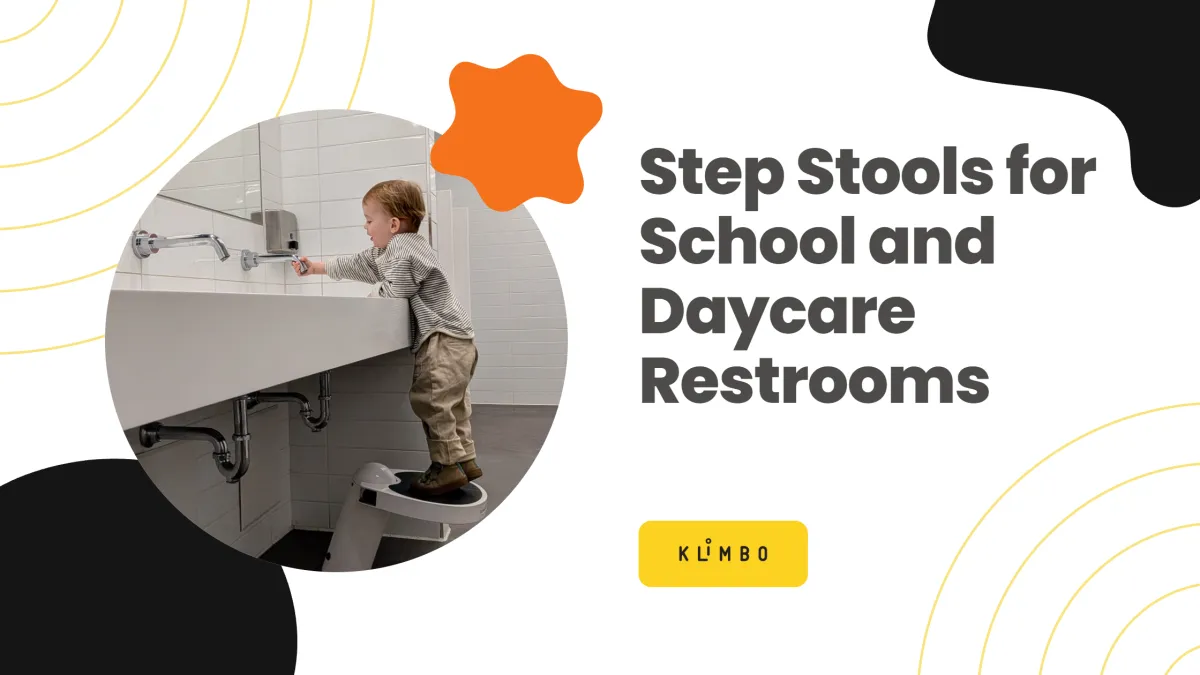
Daycare Bathroom Design: Helping Children Reach the Sink
Handwashing in a preschool restroom runs into the same gap in most schools and daycares: the sinks were built for adults, and the children using them cannot reach the faucet or the soap. Kids end up climbing on pipes, skipping handwashing, or waiting for an adult to lift them. A commercial step stool closes that gap, but only if it is built for the traffic and safety needs of a school.
This guide covers what to look for in a step stool for school and daycare restrooms, and where each option fits.
Why young children need a step stool at the sink
A standard restroom sink sits around 31 inches high. A typical four year old stands about 40 inches tall, which puts the basin near chest height. Without help, washing hands becomes a struggle, and the result is predictable: rushed rinses, water on the floor, and children who simply stop trying. In a daycare or primary school, that is both a hygiene problem and a supervision burden.
A fixed step at the sink lets children wash their hands on their own. It supports the independence young kids are learning, and it frees staff to supervise instead of lifting.
The problem with loose step stools in school restrooms
Many schools reach for a portable plastic stool first. It is cheap, and it disappears just as fast. Loose stools get kicked across the room, slide on wet tile, walk off to other rooms, and become a tripping hazard the moment a child leaves one in the wrong spot. In a building responsible for dozens of small children, a stool that moves is a liability waiting to happen.
A step that stays put, and folds away when no one needs it, removes that risk.
What to look for in a step stool for school restrooms
Durability. School restrooms see constant use. Choose a step rated for heavy daily traffic, not a household stool that fails in a single term.
Foot operated. A hands free step means children never touch a shared surface to raise it, which keeps germs off small hands.
Non slip platform. Wet floors are a given. A slip resistant surface keeps footing secure.
Easy to clean. Anti microbial surfaces wipe down fast and fit a custodial routine.
Retractable. A step that folds away leaves a clear floor for the next user and for cleaning.
How Klimbo fits school and daycare budgets
Klimbo makes commercial retractable step stools designed for exactly this setting. The K02 is the practical choice for schools, daycares, and municipal buildings: it is anchored to the floor as a permanent fixture, the step folds away when not in use, and it is built to handle hundreds of users a day. There is no loose stool to chase and nothing for a child to trip over.
For phased rollouts or tighter budgets, the K03 is modular and can be repositioned, so a school can start with one or two restrooms and expand. Every model comes in light grey or a custom color to match the space, and Klimbo provides spec sheets and installation guides for facilities teams.
Frequently asked questions
What age is a school restroom step stool for? Klimbo steps are built for ages two to twelve and for shorter adults, which covers daycare through primary school.
Is a fixed step stool safe for young children? Yes. Because the K02 is anchored to the floor and foot operated, it does not slide, and the step folds away when no one is on it.
How many do we need? Most schools start with one per restroom at the child accessible sink. Klimbo can help you map this on a quick call.
How long does installation take? Each unit ships with an installation guide, and a facilities team can fit it without a renovation.
Help children reach the sink in your school
If your school or daycare restrooms still rely on loose stools, a fixed retractable step is a small change with a real payoff in hygiene and safety. See the Klimbo range or book a free consultation to find the right fit for your building.Related reading: school restroom accessibility for children and how to improve child accessibility in public bathrooms without renovation.
A daycare washroom serves children as young as two, the age Klimbo designs for. The K01 and K02 anchor to the floor, retract automatically, and carry stainless hardware for daily washdown. Get the specification data your project needs at klimbo.co/en-specification or browse the models at klimbo.co/commercial-step-stools.
Equipping a childcare centre? See our step stools for daycare restrooms.
Buying for an arena, library, pool or daycare? Our page for municipal and institutional buyers explains which model fits, how to write it in as basis of design or approved equal, and how to order: Klimbo for municipal buyers.
