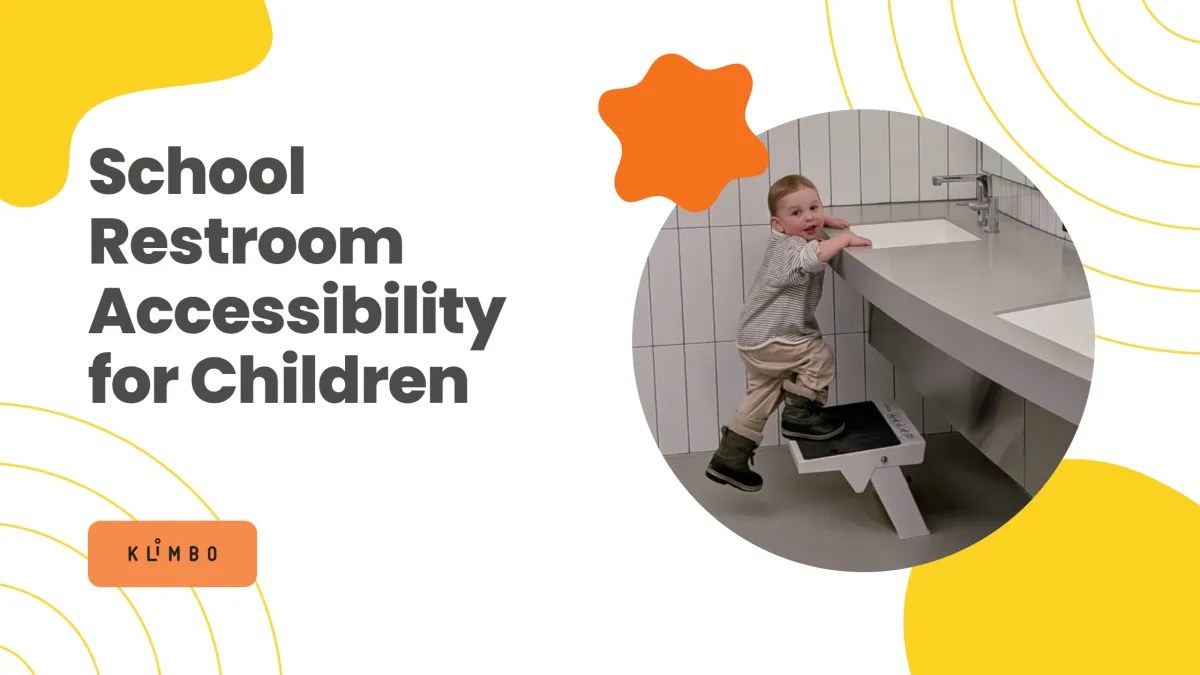
School Restroom Accessibility for Children
A school restroom is one of the few rooms in a public building used almost entirely by children, and one of the few where an adult is rarely present to help. That combination makes it worth looking at closely. This is what actually makes a school restroom hard for a small child to use, what the accessibility standards cover, and which fixes are realistic in a building that already exists.
One restroom, a very wide range of heights
An elementary school can hold children from four to twelve years old. Between those two ages a child grows roughly two feet. A room fitted out for the older end leaves the youngest reaching above their shoulders; a room fitted for the youngest is uncomfortable for the oldest and for every adult who works there.
Most schools resolve this by building to adult dimensions and accepting that the youngest grades will struggle. That decision is invisible on a drawing and very visible at ten in the morning outside a kindergarten classroom.
What the standards actually require
Under the 2010 ADA Standards, a lavatory is installed with the front of the higher of the rim or counter surface no more than 34 inches above the finished floor. Where a sink is primarily used by children twelve and under, specifications based on children's dimensions may be followed instead: for ages six through twelve a forward approach is required, and a reduced knee clearance of 24 inches is permitted when the rim sits no higher than 31 inches.
Those children's provisions are written as exceptions, which makes them optional alternatives rather than a second mandatory rule. A school can use them. Many do not, because one set of fixtures has to serve every grade, the staff, and visiting adults.
The part no standard describes
Even the children's dimensions stop short of the youngest users. A 31-inch counter is a good height for a nine-year-old and still above the shoulders of a four-year-old. And no accessibility standard describes vertical reach for a small person who is standing, because none was written for that user.
So the four-year-old is left to solve it themselves: on tiptoes, hanging off the counter edge, or climbing. None of that appears in a code, and none of it is a compliance failure.
What it costs a school day
The consequences are practical. Handwashing gets skipped, which matters most in the grades where illness spreads fastest. Water ends up on the floor and on uniforms, because a child who cannot see into the basin aims by feel. Bathroom breaks run long when a class of five-year-olds has to take turns being lifted or helped. And a child who climbs on a counter edge or a trash can to reach the faucet is doing something no one wants to see on an incident report.
Autonomy is the real goal
Ask any early-years teacher what they want from a restroom and the answer is rarely about fixtures. It is that a child can go, wash, and come back without an adult. Independence at the sink is part of what a school is teaching in those grades, and a room that makes it impossible quietly works against that.
It also changes what supervision costs. Every child who cannot reach is a child who needs someone, and that someone is a teacher who has left the rest of the class.
Fixes that do not require moving plumbing
Lowering a sink means opening a wall, and dropping a fixture below the accessible range trades one user's access for another's. Adding a second, lower sink works in new construction, where there is floor space and budget for another rough-in; in a retrofit it is usually the first item cut.
Portable stools are the common improvisation, and every school that has tried them knows the failure modes: they slide on a wet floor, they wander to other rooms, they get kicked into a corner, and someone has to clean around them.
The alternative is a step that belongs to the room. A retractable step stool folds back under the vanity when it is not in use, so it does not occupy the clear floor space the standards require, and it is operated with the foot rather than by hand, which matters in a room where the point of the trip is hygiene. The K01 and the K02 are anchored to the floor, which is the difference between a fixture and something a school has to keep track of.
What to check in your own building
Three checks are worth doing before the next renovation cycle. Measure the actual rim height in the youngest grades' restroom and compare it to the shoulder height of a four-year-old. Watch one class cycle through and count how many children need help. And ask the custodial team what they find on the floor and what they find children standing on. Those three answers describe the room better than any drawing.
Our step stools for schools page covers how a retractable step is installed in a school restroom, and the Klimbo K02 is the model most often specified for schools and daycares.Related reading: How to improve child accessibility in public bathrooms without renovation and commercial bathroom accessibility standards for public institutions.
The figures above are set out in full in ADA restroom sink height and the children’s reach ranges.
A school washroom serves a narrower age range than most public buildings, which makes the fixture choice easier. Klimbo's K01 and K02 are built for children aged 2 to 8, anchored to the slab, and carry a 5 and 3 year warranty respectively. Full specification data for your drawings: klimbo.co/en-specification.
